Sarah Carter
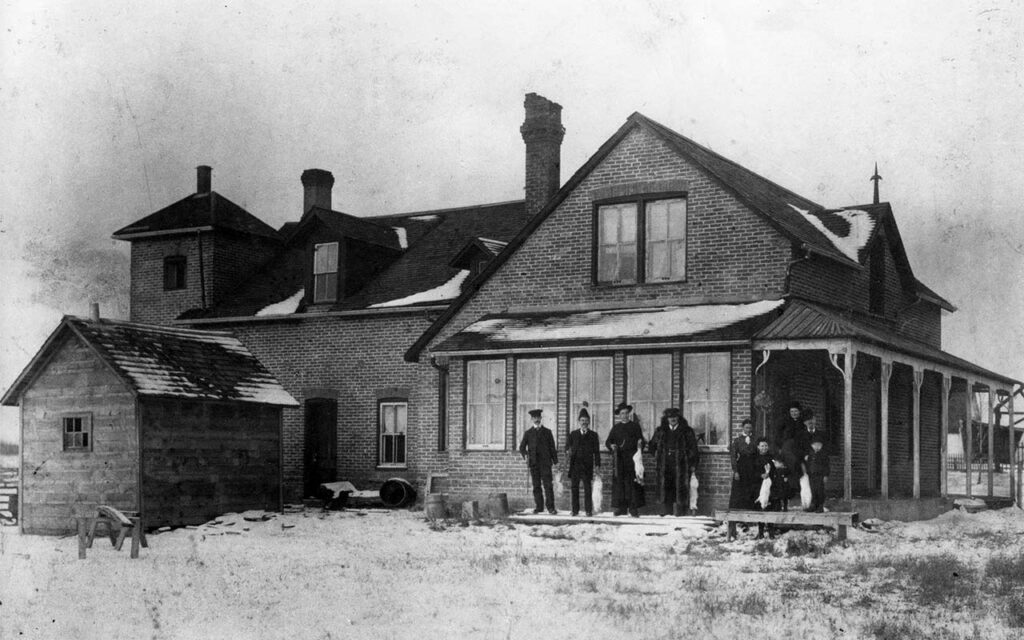
Irish-born settler James Gibbons (1837 – 1927) was an early and prominent landowner in the Town of Jasper Place (JP). He is remembered through James Gibbons School (K – 6) in JP that opened in 1955, and the area known for decades as the “Gibbons Estate” became the neighbourhood of Lynnwood in 1958. His widow, Mary Isabelle (Gouin) Gibbons, continued to live in Jasper Place until her death in 1956, and several of their children (Wilfred, William, Robert) continued as JP residents for some time afterwards.
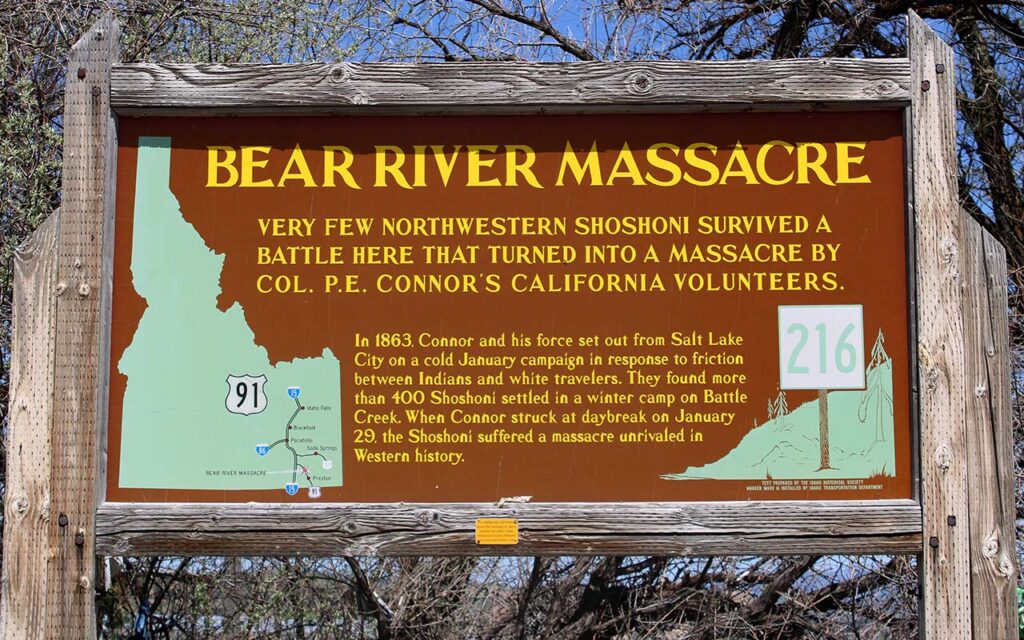
James Gibbons appears to have left Ireland at age 15, having attended a Protestant school until that time, and having worked on his father’s small farm.[i] He first went to the U.S. where he was a gold miner in California, then on the Fraser River in British territory, and then in Oregon, Idaho, Montana, and Utah. He also worked in the U.S. at various jobs including driving a mail stagecoach, and working in the liquor business and as a boatman. In 1863 he volunteered for service in the California Volunteer Cavalry under Irishman Colonel P.E. Connor and participated in the Bear River Massacre in Idaho in which hundreds of Shoshone men, women, and children were killed.[ii] It has been called the “worst slaughter of Native Americans in U.S. history.”[iii] About two dozen U.S. volunteer soldiers died at Bear River.
Gibbons then went to Fort Steele in the Kootenay district where he heard of gold in the Edmonton region. He first arrived here in the spring of 1865 after arduous travel and numerous scrapes and adventures. He mined for gold, and was credited with discovery of the “grizzly,” a device for washing gold.[iv] He hunted buffalo and in 1869 took up trading in furs and buffalo robes, first with the Blackfoot at Rocky Mountain House offering “rum, powder, shot and some dry goods and trinkets.”[v] He got 108 buffalo robes and nine horses for a keg of rum, which persuaded him it could be a lucrative trade. He frequently travelled to Red River/ Winnipeg to sell furs and robes, and loaded up there with trade goods that usually sold in Edmonton for a good price. Gibbons traded liquor diluted with water and defied the liquor permit laws; he boasted that in 1874 he left Winnipeg with 30 gallons when he was legally permitted only two.[vi]
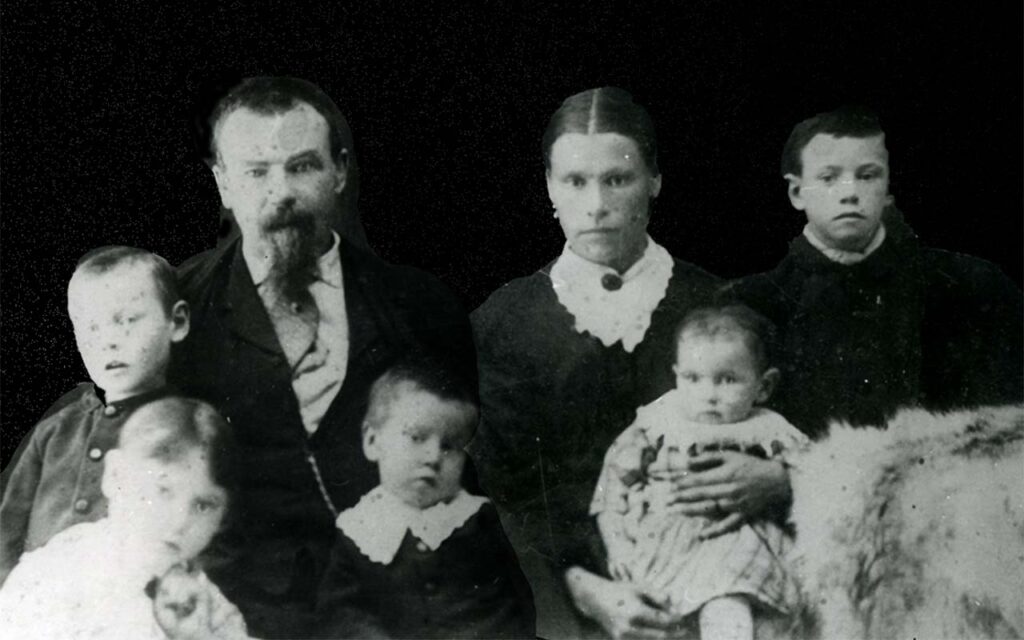
In 1873 Gibbons was married to 14 (or perhaps 13) year old Métis girl Mary/ Marie Isabelle Gouin, who moved to Edmonton from Manitoba at age three with her mother Mary/ Marie Gouin (née Ducharme). Mary Isabelle’s father, Antoine Gouin, was either deceased or had left his family by the time the two Marys settled in Edmonton along with a party of nuns and priests.[vii] Mary Gouin Sr. married Englishman Gilbert Anderson, an associate of James Gibbons in mining enterprises, and previous to that, a labourer with the Hudson’s Bay Company (HBC). The wedding of Mary Isabelle and James Gibbons was performed by Father Leduc at St. Albert mission. They had 13 children. Not all survived early childhood; Neil, born in 1877, died age 2, Charles Neil, born in 1879, died age 7, and William Edward died in 1899.
Mary Isabelle signed her name with an “X,” and while sources indicate she spoke French only, her 1885 scrip application stated that the form was explained to her in English.[viii] That scrip application was approved for 240 acres of land. She became the owner of land NE ¼ and N ½ of the SE ¼ of Section 10, Township 53, Range 25, West of the 4th Meridian. She sold this land in 1888 to Edmonton merchants Edward F Carey and John Norris Sr. for $240.[ix]
In 1900 James Gibbons applied for Métis scrip as heir to his deceased children Neil, Charles Neil, and William Edward. This was approved, and Gibbons was granted two land scrips (480 acres) and one money scrip.[x]
In 1868 Gibbons spent the winter in a dugout near what became the Edmonton Country Club, west of what would become Jasper Place. In 1869 Gibbons claimed land at Miner’s Flat, now known as Laurier Park. Once the land was surveyed, this became section 24, township 52, range 25, and consisted of 125 acres. According to his 1886 successful patent application for that land which he claimed as his homestead, he began to reside there in 1878 and he had lived there continuously except when absent in the spring of 1885 serving with General T.B. Strange’s column in pursuit of Cree/ nehiyawak Chief Mistahi-maskwa /Big Bear and party. In his 1886 application for patent he stated he was 44 years old, married with five children (two were deceased), and had been engaged in trading, mining, and farming.[xi] He stated in another document that he lived on his Miner’s Flat land until 1887 when he moved (presumably with his family) to Edmonton, though the family lived on the homestead in the summers. According to one report he sold his homestead for $48,000.00, which would have been a substantial fortune.[xii]
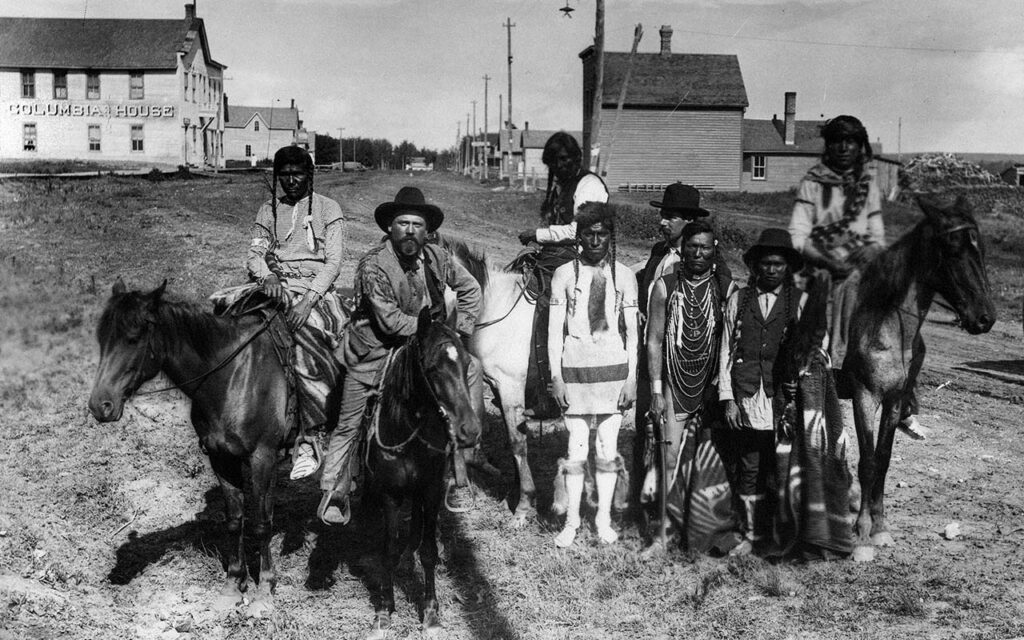
Around 1891 James Gibbons established a wholesale liquor store next door to the Big Hotel which he rented in 1893, changing the name of this “stopping house” to Columbia House. His liquor store remained in business until 1898. Gibbons was a friend of Frank Oliver, founder of the Edmonton Bulletin, politician, and advocate for the surrender of First Nations reserve land. Oliver used his newspaper to lead the successful campaign to evict the Paspaschase First Nation from their reserve in South Edmonton.[xiii] Gibbons was active in the Liberal party including as President of the Liberal Association of Edmonton.
In 1893 Gibbons applied for a second homestead (SW S 26 – T 52 – R 25), in Jasper Place.[xiv] He claimed in a letter to Thomas Anderson, Crown Timber Land Agent, that “my reasons for having made this request was that having settled long before the country was surveyed and after the survey I found that the River cut off a large portion of my present homestead and in consequence either had to take what was left of loose [sic] all my improvements.” He stated he believed “as I am an old timer of 28 years in the place I consider that I am entitled to a second homestead…” This application was controversial and remained in limbo for some years. In October 1898 an Ottawa Department of the Interior official wrote the Dominion Lands Agent in Edmonton that Gibbons did not satisfactorily comply with the requirements of the law as there was no evidence of residence duties on this land where he was to have made improvements and resided for at least six months each year. At this point Gibbons’ old friend Frank Oliver, now in government with the Wilfrid Laurier Liberals, asked the Dominion Land Commissioner to excuse Gibbons from completing residence duties. When this was denied, Oliver asked if Gibbons could purchase the second homestead at a dollar an acre. Oliver added, as will be discussed below, that Gibbons could not perform residence duties as he had been appointed Indian agent. The matter was still undecided in 1901 when the agent for Dominion Lands in Edmonton wrote Ottawa once again, this time successfully, to urge that Gibbons be allowed to purchase this land. It helped to have friends in high places to circumvent the Dominion Lands Act. A settler such as Gibbons, a new arrival in the West compared to the First Nations, could acquire vast acreages, while under the terms of Treaty 6, every family of five was entitled to one square mile of a shared reserve. These acreages shrunk on many First Nations reserves however through the work of Oliver and Gibbons who sought to diminish their land base.
According to the Western Land Grants website of the Library Archives Canada James Gibbons gained patent to the following
●PT FR N S 24 – T 52 – R25- W4
●W ½ SW S 25 –T 52- R25 – W4
●SW S 26- T52 – R25 – W 4
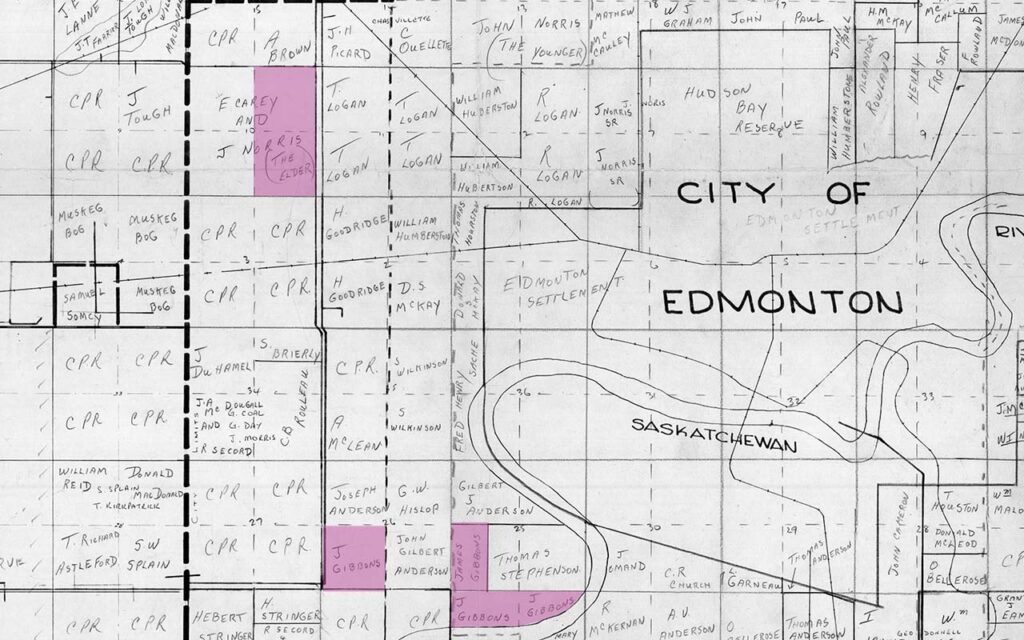
Gibbons also owned land in Edmonton, where he built a substantial five bedroom home in 1911 (first called St. Catherine’s Street but now still standing at the address 10534 125 Street. He purchased the lot in 1911 for $3,000 and the one immediately south of it. His home on the northern lot cost $7,000. In 1913 he built a home on the southern lot for the same price.[xv] Gibbons also owned land that he sold in 1907 to the City of Edmonton water works site, land that he had held for 42 years. He received $25,625 for this land, the exact location of which is unclear. Altogether he would have amassed a substantial fortune. How did a bootlegger turned Indian agent acquire such a windfall?
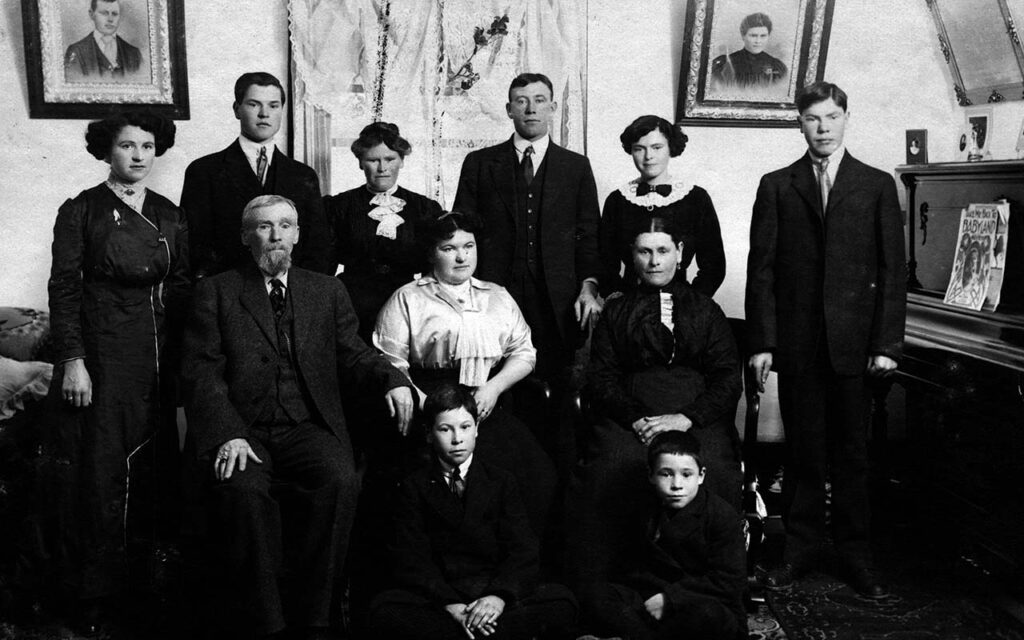
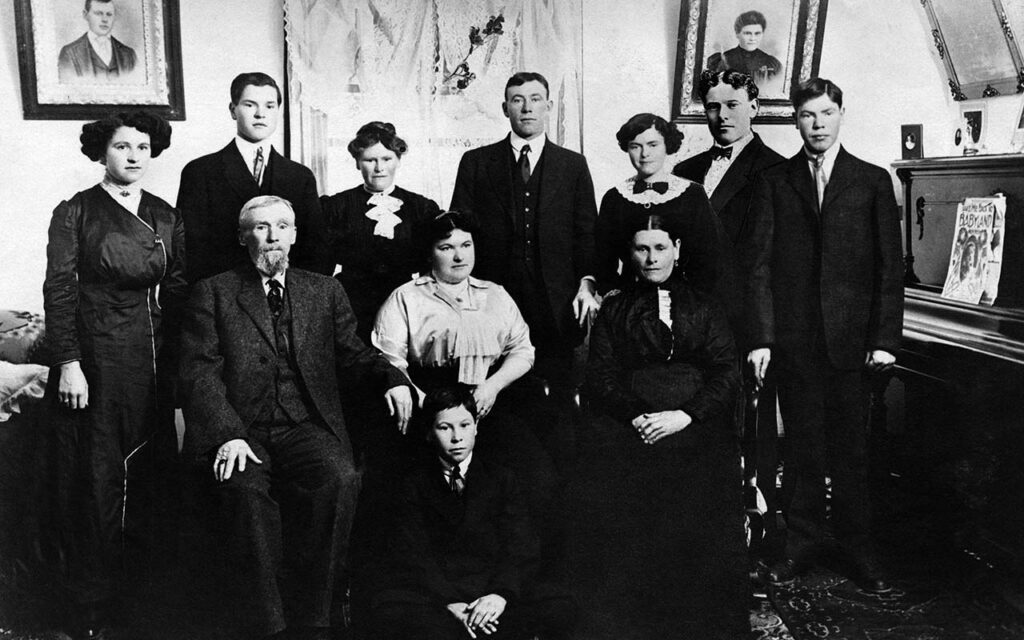
In 1898 Gibbons was appointed Indian agent of the Edmonton Agency that was comprised of five First Nations: Enoch/ Stony Plain, Michel, Alexander, Joseph, and Paul. He received an annual salary of $1,000.[xvi] These reserves were to the west of Edmonton, and Enoch/ Stony Plain (hereafter Enoch) was the closest to Jasper Place. The agency office was on the Enoch First Nation, about eight miles west of Edmonton, where Gibbons would have lived and where he oversaw a staff of a clerk, three farmers, and an interpreter.[xvii]
The appointment of Gibbons was controversial; he had the strong support of Oliver and Father Albert Lacombe, but Minister of the Interior Clifford Sifton was reluctant to approve the appointment because Gibbons was a bootlegger, almost sixty years old, and had been a mercenary “Indian fighter” in the U.S.[xviii] Gibbons’ qualifications for the role would have been his loyalty to Oliver as well as his views of Indigenous Peoples. As he wrote in his report in June, 1903 on his work as agent, “In my forty years dealing with Indians…[he had] never met an Indian who would not steal, lie and be immoral…”[xix] He spoke some Plains Cree/ Nehiyawak. Indian Affairs’ correspondence indicates that he sometimes acted as interpreter, although an interpreter was required at the agency and worked under his supervision.[xx] There were at least two Indigenous languages spoken in the agency: Nehiyawak and Nakoda.
Before the appointment of his friend Gibbons, Frank Oliver had been trying to discredit and get rid of Indian agent Charles de Cazes because he failed to make progress on reserve land surrenders. Oliver wanted his friend Gibbons hired, and he initiated two inquiries into de Cazes’ handling of the agency.[xxi] In 1897, Oliver recommended that Gibbons be consulted by A. McDonald, a Department of Indian Affairs (DIA) official who was assigned to enquire into the (alleged) complaints of an Enoch deputation of men about their Indian agent. Gibbons, described in correspondence as “liquor merchant,” gave information to McDonald on each member of the deputation.[xxii] Yet McDonald did not provide the recommendation that Oliver desired; he praised the work of de Cazes and the progress made by the Enoch band. Agent de Cazes died in July of 1898 after a lengthy illness, paving the way for the appointment of Gibbons.
The other main qualification Gibbons had for his appointment as Indian agent was his willingness to vigorously pursue reserve land surrenders. In the case of Enoch the pressure mounted from farmer settlers, town settlers, and politicians to “throw open” the reserve. Groundwork was laid by DIA officials’ erroneous claims that “the Indians are not making use of the land…” and had a surplus of land.[xxiii] Through the Edmonton Bulletin, Oliver campaigned to have Alberta First Nation reserves opened to settlement. The Enoch residents were clear they opposed giving up any of their land. Agent Charles de Cazes failed to persuade them to surrender any land before his death. They told de Cazes in an 1898 statement signed by 25 male members that “We do not want to sell any portion of our Reserve because it will bring the White settlement nearer our own settlement, also because there are graves all over the reserves, which would be disturbed if any portion of it were sold and we want to live and die on the reserve as it is.”[xxiv]
Gibbons made his opinions clear in a 1901 report where he advocated throwing open for non-First Nation settlement the entire Enoch reserve and moving the residents “to a small reserve at the foothills of the Rockies,” where they could fish and hunt.[xxv] This was Oliver’s goal, which he expressed in 1898 to the Minister of the Interior, writing that Enoch “ contains some of the choicest land of that Country, and is most desirable for settlement; and its few Indians would be better accommodated else-where, and I have no doubt would be willing to enter into a reasonable arrangement for removal.”[xxvi] Gibbons reported in 1901 that the Enoch residents were “rapidly dying off (20 dying last year)…” He claimed very few farmed and asked “are we to feed this Band forever?” Farming at Enoch had been progressing well prior to the appointment of Gibbons; it is probable that he discouraged and undermined progress in order to facilitate land surrender. The Inspector of Agencies reported in 1901 that little farming or gardening occurred at Enoch and that “the land is foul, overgrown with weeds, and the crops yield little return for the labour.”[xxvii] This was in contrast to the report of A. McDonald in 1897 who praised the agricultural situation on the Enoch First Nation.
Gibbons and Oliver failed to eradicate the reserve entirely; DIA officials endorsed a surrender of fourteen square miles of the Enoch reserve. In 1902 Gibbons presided over the surrender of 9113 acres of the reserve, surveyed in 1884, land promised under Treaty Six to be the domain of the First Nation forever. The legality of this surrender is dubious; 14voters “signed” the surrender document, and it is unlikely these were the majority of voters of the band (males over the age of 21 as required by the Indian Act). In 1903 the band had a population of 129; so there must have been more males over the age of 21. Records have not been located of what was proposed or explained at the meeting, its location, and the prior notice given of the meeting.[xxviii] Another 6,362 acres of Enoch were “surrendered” in 1909.
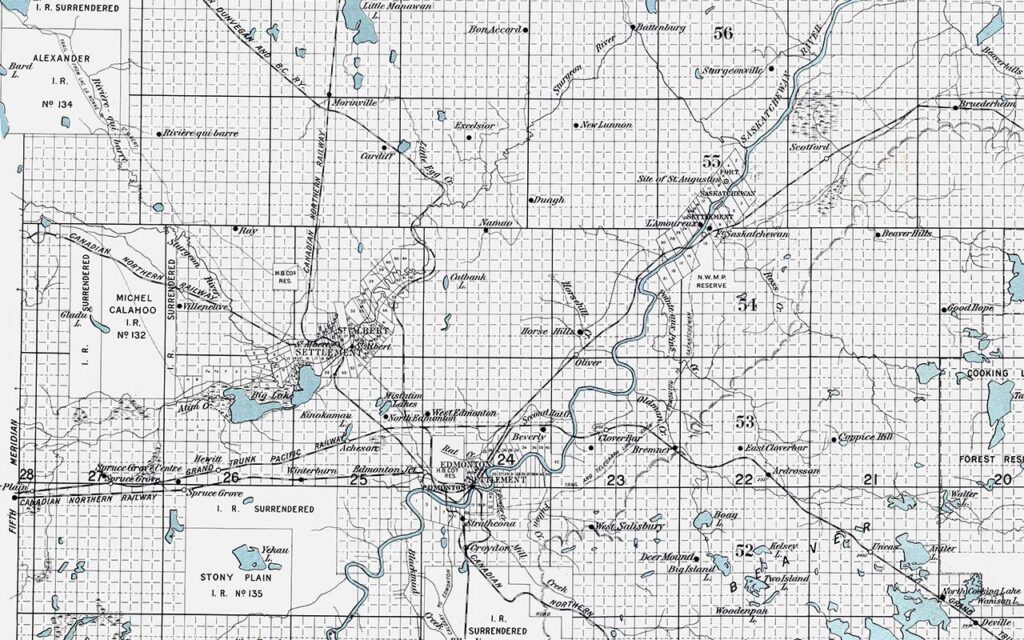
The Michel First Nation was induced to surrender 7,800 acres of land in 1903, and another 2,400 in 1906. Gibbons helped to facilitate these. There is no proper documentation of the number of voters present, or details of the meeting.[xxix] Gibbons also worked to secure a surrender from the Paul First Nation of their fishing station (IR 133B, approximate 635 acres) and in 1906 nine members of the band allegedly agreed to this. Again there is meagre documentation including no record of the vote or of a voters’ list. There are no minutes of what took place at the meeting.[xxx]
Demands for strict adherence to DIA policies and Indian Act laws assisted Gibbons to intimidate people into submitting to his authority. Chiefs were deposed by DIA officials if they were not obeying laws and orders. In 1901 Gibbons had Chief Paul (of Paul First Nation) deposed as “incompetent… for the reason that he has killed cattle on the reserve without authority and endeavoured to get his Indians to act in a like manner. He also used abusive language to the Agent for punishing a trader who sold liquor to the Indians…”[xxxi] This latter was ironic in the extreme as Gibbons had worked many years as a trader providing rotgut to the First Nations. The permit system, despised by First Nations throughout the prairies, demanded the written permission of the agent before livestock could be sold or butchered and it was protested by reserve farmers and ranchers for decades. But Gibbons boasted that this move had the desired result and intimidated other leaders into submission. He reported that the Alexander First Nation had ceased to kill their stock, ”greatly owing to Chief Alexander’s fear of being deposed for allowing the practice to go on, as he got an ‘eye-opener’ when Chief Paul was deposed.”[xxxii] Chief Paul had the largest grain farm on the reserve where there were also 90 head of cattle in 1900.[xxxiii] He, like many other First Nation ranchers and farmers, likely believed they were the best judges of when they needed to butcher or sell.
Gibbons retired as Indian agent in 1907. In his retirement years he was celebrated as Edmonton’s most eminent “old timer” who had an illustrious career as “boatman, fur trader, farmer, fighter, and government official” and was “now spending a comfortable old age.”[xxxiv] He was featured in a 1914 history of the Catholic Church in Central Alberta as one of the “intrepid souls” and “hardy pioneers” who had “ventured into the comparatively unknown wilderness…”[xxxv] He had a keen memory as is evident from his memoirs dictated in 1922 to his friend, W.A. Griesbach, former North West Mounted Policemen, lawyer, military man, and politician.
At the time of his death, Gibbons was no longer living in his substantial brick home on 125th street. Instead he had resided for many years at his Jasper Place farm west of Edmonton near the Country Club.[xxxvi] Mary Isabelle, known as “Grandma Gibbons, one of the real old-timers of the Jasper Place Edmonton district,” lived on there until her death at age 96 in 1956.[xxxvii] She was an active and life member of the Edmonton Pioneers and Old Timers’ Association. Her death was noted in an article on the front page of the Edmonton Journal.[xxxviii] She had “maintained her enthusiasm for reels and jigs” until she was well over 80.
James Gibbons’ funeral in January 1927 was at St. Joseph’s Cathedral and he was buried in Saint Joachim cemetery. The article in the Edmonton Journal on his death concluded with “on his passing, the oldest link in the chain of the early days is broken, but his name will live in the history of his adopted home as a man who blazed the trail for future years…” An editorial on Gibbons in that newspaper concluded with “Among other old-timers there was no one held in greater respect and admiration, and they and all who now have their homes here must deeply regret his passing…” Settler narratives woven about James Gibbons are prime examples of how settler society lionized and celebrated those who dispossessed Indigenous Peoples of their lives, land, livelihoods, resources, and liberty, and profited from this dispossession, while erasing and eliding their perspectives and experiences.
Notes
[i] There are discrepancies in accounts of when Gibbons was born and at what age he left Ireland for North America; I have taken these dates from the narrative of his life recorded in 1922 by W.A. Griesbach, ed., “The Narrative of James Gibbons,” Part I, Alberta Historical Review 6:4 (Autumn 1958). In “A Historical Sketch,” of the life of James Gibbons, Elk City Mining News (Idaho) 9 Jan., 1913: 4 his date of birth is given as 1834, and that he left Ireland at age 16.
[ii] Griesbach, ed., “Narrative of James Gibbons,” Part I, 2 – 3. This battle is also known as Battle of Bear River or Massacre at Boa Ogoi. Estimates vary of the number of Shoshone killed, from 250 to 493. In his narrative Gibbons stated that there was a large encampment of women and children and “we finished them all off.”
[iii] Dana Hedgpeth, “This was the worst slaughter of Native Americans in U.S. history. Few remember it.” The Washington Post, 26 Sept 2021, available at https://www.washingtonpost.com/history/2021/09/26/bear-river-massacre-native-americans-shoshone/
[iv] “The Inventor of the ‘Grizzly’” Edmonton Bulletin 27 May, 1922: 7.
[v] Griesbach, ed., “Narrative of James Gibbons,” Part 2: 10.
[vi] Ibid., 13.
[vii] Marie/ Mary Ducharme, the mother of Mary Isabelle Gibbons, was the daughter of Amable O.C. Ducharme and Genevieve Gladu, and was born in 1834 in St. Boniface. She married Antoine Gouin and then Gilbert Anderson.
[viii] Gibbon,[sic] Mary Isabelle- Concerning her claim as a child. LAC, RG 15 – D-II-8-b. v. 1328.
[ix] Gibbons, Mary Isabelle of Edmonton to Carey, Edward Francis and Norris, John Sr. both of the same place, Merchants. LAC RG 15 15 – D-II – 8 – 1 V. 1433.
[x] Gibbons, James; heir to his deceased children… LAC RG 15 – D – II – 8 – c v. 1349.
[xi] Provincial Archives of Alberta (PAA) file 97195, reel 2003. Gibbons was granted a homestead and pre-emption on 8 Aril 1886. A pre-emption was a short-lived option under the Dominion Lands Act for a homesteader to also claim an adjoining quarter section. I can’t tell from the document which quarter section was his pre-emption.
[xii] “A Historical Sketch” Elk City Mining News
[xiii] Matthew Konhauser, “Frank Oliver’s Edmonton Bulletin and the Removal of the Papaschase, 1880 – 1888,” Alberta History 71: 4 (Autumn 2023): 2 – 12.
[xiv]This correspondence is all in PAA file 46307, reel 2046 for the land S26 – T 52 – R 25. This is the land that became the neighbourhood of Lynnwood and was previously known as the Gibbons Estate.
[xv] Jac MacDonald, “Soldier of Fortune Built Georgian Revival Two-Storey,” Edmonton Journal, 27 Feb., 1987: 59.
[xvi] Appointment of James Gibbons as Indian Agent for Edmonton Agency… LAC Order-in-Council 1898-2359 Series A-1-d V. 2792.
[xvii] In the 1901 census James Gibbons, age 61, and his wife Mary, age 43 are living on the Stony Plain Reserve along with children Robert 14, Rosie 18, Louise 11, Alice 9, Albert 7, Wilfrid 4 and William C, an infant. Their son James Gibbons Jr. age 20, a labourer, is living in Edmonton West (likely Miner’s Flat?) near his grandmother and her husband Mary and Gilbert Anderson with wife Sophie (described as “Cree”) and son Vital Gibbons.
[xviii] Peggy Martin-McGuire, “First Nation Land Surrenders on the Prairies, 1896 – 1911,” Prepared for the Indian Claims Commission, Ottawa, 1998: 180 – 181.
[xix] Canada. Sessional Papers. Annual Report of the Department of Indian Affairs for the year ended 30 June, 1902: p. 149.
[xx] A. McDonald to Indian Commissioner, 8 Sept. 1897, Library Archives Canada, (LAC) Record Group 10 (RG 10) Indian Affairs, v. 7542, file 29, 110-6.
[xxi] McGuire, 180 – 181.
[xxii] Ibid.
[xxiii] J. McKenna Memorandum for the Superintendent General DIA, 3 Jan., 1902 LAC, RG 10 v. 7542, f. 29,110-6.
[xxiv] Quoted in “Specific Claims Tribunal Between Enoch Cree Nation v. Her Majesty the Queen in Right of Canada,” SCT File No. SCT – 6001 – 20, 8 May, 2020: 3. See also J. D. McLean to Frank Oliver 26 April, 1898 in Ibid.
[xxv] Jas Gibbons to Secretary, Indian Department, 20 Dec., 1901 in Ibid. In his 1897 report, cited above, A. McDonald who wrote “from my experience as an Agent I consider it [Stony Plain Reserve] to be in excellent shape and is a credit to both Indians and the management.” He described good gardens and crops, with hay stacks, houses and stables in good order. They had 149 head of cattle as well as pigs and poultry, and farm implements including wagons, mowers, rakes and a binder.
[xxvi] F. Oliver to Clifford Sifton, 6 March, 1898 in Ibid.
[xxvii] Canada. Sessional Papers. Annual Report of the Department of Indian Affairs for the year ended 30 June, 1901: 181.
[xxviii] Peggy Martin-McGuire, “First Nation Land Surrenders on the Prairies, 1896 – 1911,” Prepared for the Indian Claims Commission, Ottawa, 1998: 253 – 256.
[xxix] Ibid., 181 – 2, 259.
[xxx] Indian Claims Commission. Paul First Nation Kapasiwin Townsite Inquiry, Feb. 2007: 7.
[xxxi] LAC, Order-in-Council 1901 – 1761 RG 2, Privy Council Office, Series A-1-a v. 828
[xxxii] Canada. Sessional Papers. Annual Report of the Department of Indian Affairs for the year ended 30 June, 1902: 148.
[xxxiii] “White Whale Lake,” Edmonton Bulletin, 15 June, 1900: 4.
[xxxiv] “Old Timers Honored at Edmonton,” The Ottawa Journal, 11 Jan., 1913: 13.
[xxxv] “Emile Joseph Legal, Short Sketches of the History of the Catholic Churches and Missions in Central Alberta, (Winnipeg: West Canada Publishing Co., 1914): 149.
[xxxvi] “Adventurous Life of James Gibbons Ends,” Edmonton Journal, 8 Jan., 1927: 1
[xxxvii] “Grandma Gibbons Misses Coach Ride,” Jasper Place Citizen, 30 June, 1955: 1 This was likely 8744- 152 St., R.R. # 5 Jasper Place.
[xxxviii] “Mrs. J. Gibbons, ’62 Pioneer, Dies,” Edmonton Journal, 25 Jan., 1956: 1, 3.
Further Reading
Settler Colonial Land Laws, Policies and Land Grabbing in Canadian and International Contexts
Allen, Douglas W. “Homesteading and Property Rights: Or, ‘How the West Was Really Won.’” Journal of Law and Economics 34, no. 1 (April 1991): 1–23.
Belich, James. Replenishing the Earth: The Settler Revolution and the Rise of the Anglo-World, 1783–1939. Oxford: Oxford University Press, 2009.
Carter, Sarah. “’Daughters of British Blood’ or ‘Hordes of Men of Alien Race’?: The Homesteads-For-Women Campaign in Western Canada” Great Plains Quarterly, 29:4 (Fall 2009): 267 – 286.
Carter, Sarah. “Erasing and Replacing: Property and Homestead Rights of First Nations Farmers of Manitoba and the Northwest, 1870s–1910s.” In Place and Replace: Essays on Western Canada, edited by Adele Perry, Esyllt W. Jones, and Leah Morton, 14–39. Winnipeg: University of Manitoba Press, 2013.
Carter, Sarah. Imperial Plots: Women, Land and the Spadework of British Colonialism on the
Canadian Prairie. Winnipeg: University of Manitoba Press, 2016.
Carter, Sarah. Lost Harvests: Prairie Indian Reserve Farmers and Government Policy. Montreal
and Kingston: McGill-Queen’s University Press, 1990.
Carter, Sarah. “’My Vocabulary Contains No Such Word as Defeat’: Clara Lynch and Her Battle For Her Alberta Homestead, 1908-1909 Alberta History 61: 3 (Summer 2013).
Carter Sarah and Nathalie Kermoal. “Property Rights on Reserves: ‘New Ideas” From the 19th Century.” In Creating Indigenous Property: Power, Rights and Relationships, edited by Angela Cameron, Sari Graben and Valerie Napoleon. Toronto: University of Toronto Press, 2020.
Daschuk, James Clearing the Plains: Disease, Politics of Starvation and the Loss of Aboriginal Life. Regina: University of Regina Press, 2013.
Detre, Laura A. “Canada’s Campaign for Immigrants and the Images in Canada West Magazine.” Great Plains Quarterly 24: 2 (2004): 113 – 29.
Dick, Lyle. Farmers “Making Good”: The Development of Abernethy District, Saskatchewan, 1880–1920. Ottawa: National Historic Parks and Sites, 1989.
Friesen, Gerald. The Canadian Prairies: A History. Toronto: University of Toronto Press, 1984.
Lambrecht, Kurt N. The Administration of Dominion Lands, 1870–1930. Regina: Canadian Plains Research Centre, 1991.
Morris, Alexander The Treaties of Canada with the Indians of Manitoba and the North-West Territories, Toronto: Belfords, Clarke and Co., 1880. Available on archive.org full text.
Shepard, R. Bruce. Deemed Unsuitable: Blacks from Oklahoma Move to the Canadian Prairies in Search of Equality in the Early 20th Century Only to Find Racism in Their New Home. Toronto: Umbrella Press, 1997.
Smith, Keith C. Liberalism, Surveillance, and Resistance: Indigenous Communities in Western Canada, 1877–1927. Edmonton: Athabasca University Press, 2009.
Tough, Frank, and Kathleen Dimmer. “‘Great Frauds and Abuses’: Institutional Innovation at the Colonial Frontier of Private Property: Case Studies of the Individualization of Maori, Indian and Metis Lands.” In Settler Economies in World History, edited by Christopher Lloyd, Jacob Metzer, and Richard Sutch, 205–49. Leiden, Boston: Brill, 2013.
Waiser, Bill and Jennie Hansen. Cheated: The Laurier Liberals and the Theft of First Nations Reserve Land. Toronto: ECW books, 2023.
Weaver, John. The Great Land Rush and the Making of the Modern World, 1650–1900. Montreal: McGill-Queen’s University Press, 2003.
Edmonton and District Histories for Contexts on Jasper Place
Adese, Jennifer, “’R’ is for Métis: Contradictions in Scrip and Census in the Construction of a Colonial Métis Identity” Topia: Canadian Journal of Cultural Studies v. 25, no. 1 (2011): 2-3 – 212.
Donald, Dwayne T. “Edmonton Pentimento: Re-Reading History in the Case of the Papaschase Cree” Journal of the Canadian Association for Curriculum Studies 2:1 (2004): 21 – 54.
Gilpin, John R “The Edmonton and District Settlers’ Rights Movement, 1880 – 1895,” in R.C.
Macleod, ed., Swords and Ploughshares: War and Agriculture in Western Canada. Edmonton: University of Alberta Press, 1993: 149 – 172.
Gilpin, John R. “Urban Land Speculation in the Development of Strathcona (South Edmonton), 1891 – 1912,” in The Developing West: Essays in Honour of Lewis H. Thomas, ed. John Foster. Edmonton: University of Alberta Press, 19823: 179 – 199.
Goyette, Linda and C J Roemmich, Edmonton In Our Own Words Edmonton: University of Alberta Press, 2004. This book includes a detailed timeline of Edmonton history.
Hall, David “Frank Oliver,” Dictionary of Canadian Biography, v. 16 available at
http://www.biographi.ca/en/bio/oliver_frank_16E.html
Hatt, K., “The North-West Scrip Commissions, 1885-1889.” In: 1885 and After: Native Society in Transition, edited by F.L. Barron and James B. Waldram, Regina: Canadian Plains Research Centre, 1986, pp. 189-204.
Konhauser, Matthew. “Frank Oliver’s Edmonton Bulletin and the Removal of the Papaschase, 1880 – 1888” Alberta History 71: 4 (2023): 2 – 12.
Monto, Tom and Randy Lawrence, Old Strathcona: Edmonton’s Southside Roots Edmonton: Crang Publishing, 2011
Neimi-Bohun, Melanie. “Contesting the Colonial Order on the Canadian Prairies: Government Policy, Indigenous Resistance and the Administration of Treaty 6, 1870-1890.” Unpublished Ph.D. dissertation, University of Alberta, 2016 available at https://era.library.ualberta.ca/items/2483ff70-7087-4792-b96d-72bdeed986da/view/cfa5c076-b6ae-40a8-b8e0-dbbc52a0328b/Niemi-Bohun_Melanie_A_201603_PhD.pdf
Rupertsland Centre for Métis Research in Collaboration with the Métis Nation of Alberta, Métis Scrip in Alberta (Rupertsland Centre for Métis Research, University of Alberta, 2018) available at https://www.ualberta.ca/native-studies/media-library/rcmr/publications/rcmr-scrip-booklet-2018-final-150dpi.pdf
Wesley, Jared and Sylvia Wong. “Beyond Fragments: The Canadian State and the Origins of Alberta Political Culture.” International Journal of Canadian Studies v. 60 ( 2022): 60 – 87.
Ziff, Bruce and Sean Ward, “Squatters’ Rights and the Origins of Edmonton Settlement,” in J. Phillips et.al., Essays in the History of Canadian Law: A Tribute to Peter N. Oliver Toronto: University of Toronto Press, 2008: 446 – 467.
Sarah Carter is Professor of History and Henry Marshall Tory Chair Emerita in the Department of HIstory, Classics and Religion in the Faculty of Arts, and the Faculty of Native Studies at the University of Alberta. She has researched and written histories of the North American West.