Making a Home in the West: Chinese Families in Jasper Place
Chinese migration to Canada stretches back to the nineteenth century, but for decades it unfolded under harsh restrictions. Early Chinese workers helped build the railways and ran laundries and cafés in western towns, while facing head taxes and, after 1923, an almost total ban on immigration. Only in 1947 was the exclusion law repealed; even then, Chinese families could usually come only as spouses or dependants, and most communities remained small and heavily male.
From the late 1950s into the 1960s, national policies began to shift. Regulations were relaxed to allow more family reunification, enabling Chinese Canadians who had already put down roots in cities like Edmonton to bring over parents, spouses, and children. By the 1970s, the landscape changed further: the introduction of the immigration “points system” (officially treating applicants from Asia on the same basis as those from Europe) and new programs for entrepreneurs and refugees meant that new migrants could arrive not just as sponsored family members, but as skilled workers, students, and independent business owners.
At the same time, Jasper Place was changing rapidly. Once a separate town west of Edmonton, it grew quickly after the Leduc oil discovery as new residents moved into modest post-war subdivisions along and north of Stony Plain Road. By the early 1960s, the town had expanded schools, planned recreation facilities, and taken on heavy debt; in 1964 it was amalgamated into the City of Edmonton. Former residents remember the area as having lower taxes, affordable rents, and later closing hours for shops and cafés than many other parts of the city—conditions that made it attractive, and sometimes precarious, for small businesses. Into this landscape, Chinese families began opening corner groceries and restaurants that served both neighbours and a wider west-end clientele.
Corner stores, family life, and growing westward
Several of Jasper Place’s best-remembered corner stores were owned or operated by Chinese families. Tooke’s Grocery at 9202 149 Street, run by Took Gee and his family since 1958, is recalled as a place where children raced across a gravel road to buy cigarettes for their parents, chips, or a rare popsicle. “He had his whole family working there,” one neighbour remembered; the store and home were under the same roof. [1]
Farther west, Glenwood Groceries at 16225 Stony Plain Rd — owned in the late 1950s by Loy Mah —became a favourite stop for children who turned in empty pop bottles for cold Coca-Cola, licorice, and gum. Mr. Mah’s son Paul, a standout basketball player at Britannia school, lived nearby with his wife. These stores illustrate how national policy changes translated into everyday life. As more Chinese families could reunite in Canada in the 1950s and 1960s, it became possible not only to run a corner store but also to live with children and elders on-site.
One address on Stony Plain Road shows this layering particularly clearly: 15802 Stony Plain Road, home of Westlawn Grocery & Meat. Established in 1949 by Daniel and Nettie Romaniuk, the store later became part of a handoff that brought Chinese proprietors into Jasper Place’s everyday commercial life. In the late 1950s, Ming Poon (also known as Fong See) operated the grocery; by the early 1960s, Donald and Stanley Poon were running the business and living on site, alongside members of the Romaniuk family who continued to reside at the same address.
In 1970, Westlawn briefly entered the public record in an unusual way, when Donald Poon was charged under the Excise Tax Act for allegedly selling tobacco packages that had been opened and packed with promotional “poker hands”[2]. The charge was later dismissed following trial, and Poon was acquitted [3].It is a small but telling episode: a family-run grocery on Stony Plain Road suddenly drawn into a federal legal system, at the very moment when Chinese immigration rules were loosening.
Other Chinese-connected shops dotted the former town. The Pantry at 154 Street and 97 Avenue, a grocery and meat shop built around 1946, was later operated for decades by Jim and Jane Wong, who lived in the building with their son Patrick. On 149 Street, Don’s Foodland at 8924 became another community hub, remembered in photographs of Ms. Wong standing proudly in front of the store owned by her son, Don Luke.
Taken together, these businesses mark a quiet westward extension of Chinese life from downtown Chinatown into Edmonton’s growing west side.
Stony Plain Road restaurants and evening life
As Jasper Place developed, Stony Plain Road emerged as its main commercial spine. Here too, Chinese restaurateurs found space alongside other immigrant-owned businesses. At 15545 Stony Plain Road, a modest diner run by Mrs. Nellie Goward in the 1940s evolved into “Southern Fried Chicken” in the early 1950s, then passed through a series of uses—a small shopping centre, the Grey Cup Restaurant, Venus Restaurant—before becoming a Chinese restaurant in the late 1970s under Mark Chan.
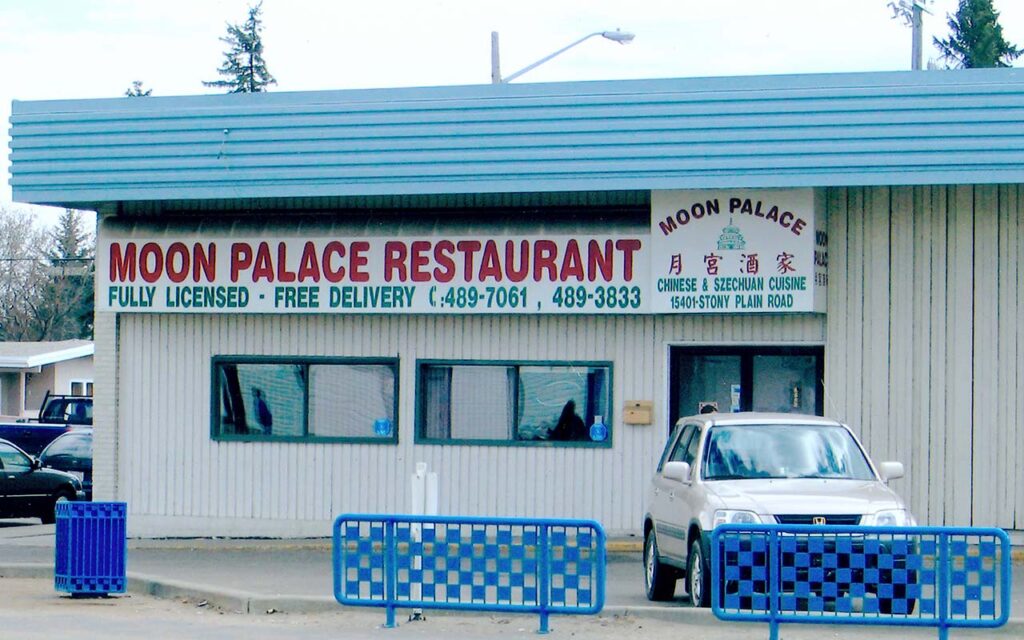
A few doors away at 15401 Stony Plain Road, Moon Palace Restaurant opened in 1970 in a former menswear shop and served diners for nearly two decades. Artist Edith Chu, whose family later ran Szechuen Cuisine nearby, remembers this stretch of Stony Plain Road as a place where Chinese restaurants, a Singaporean eatery, Caribbean-owned hair salons, a western-wear shop, tailors, and even a small police detachment all shared the same strip malls. Business owners visited each other for haircuts, traded take-out meals, and exchanged change for the till—an everyday web of relationships across cultures.
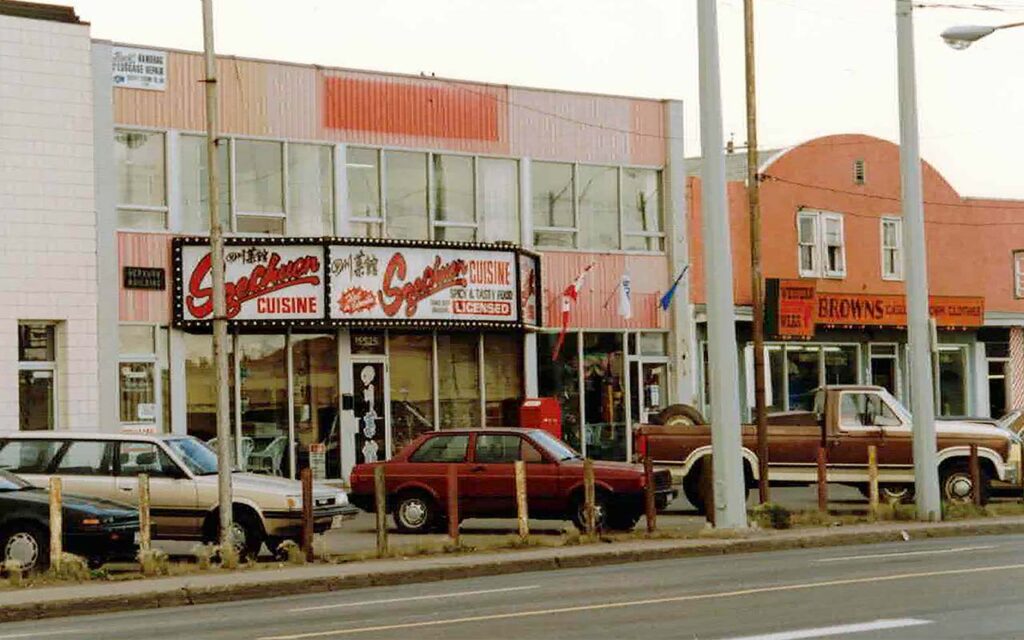
In 1984, Richard and Doris Chu, opened Szechuen Cuisine at 15525 Stony Plain Road. Their choice to advertise “Szechuan” cooking—rather than the more familiar Cantonese style—reflected changing Canadian tastes and the possibilities of a more multicultural food scene. Szechuen Cuisine was both workplace and home. Running a restaurant on Stony Plain Road also meant dealing with the rougher edges of Jasper Place’s evening economy. Edith remembers thefts, attempted robberies, and late-night encounters with customers struggling with addiction. Yet she also describes her parents’ determination to treat people with care, serving truck drivers, professionals, and vulnerable neighbours alike[4]. In this sense, Szechuen Cuisine embodied both sides of Jasper Place after amalgamation: a working-class district with a reputation for being “a bit rough,” and a place where immigrant families created community through food, hospitality, and hard work.
Traces and future stories
Beyond the visible storefronts, demographic records confirm that Chinese families maintained a small but persistent presence in the west end, growing from scattered households in the 1970s to a visible part of the community today[5]. Yet, shopping habits have shifted toward the large Asian supermarkets of newer suburbs. This marks a distinct change from the mid-century era, when the store, house, and family business were folded into one space, giving Jasper Place residents daily contact with Chinese neighbours.
Like the Indigenous, Jewish and Black communities whose histories also intersect with Jasper Place, Chinese families have made this west-end district a place of work, home-making, and community for generations.
Notes:
Business names, addresses, and operating years in this article are drawn primarily from Henderson’s Directories for Edmonton (selected years, 1940s–1980s), supplemented by oral history and local newspaper coverage.
[1] Paula E. Kirman, Food Security in Jasper Place: Part Three Corner Stores
[2] Edmonton Journal, “Remand on excise tax charge,” Apr. 3, 1970
[3] Edmonton Journal, “City grocer acquitted,” May 5, 1970
[4] Interview with Edith Chu, May 29, 2025
[5] Population trends and demographic data are drawn from Statistics Canada Federal Census records (selected years, 1986–2021) and City of Edmonton Municipal Census data, compiled for the Jasper Place Community History Project.
Jianru Li is a PhD student at the University of Alberta. Her research and community work explore Chinatowns and Chinese histories through sport, leisure, place and belonging.
To learn more about the Chinese Communities in Jasper Place, visit Jasper Place Community History Project’s website here: Category: Chinese Communities