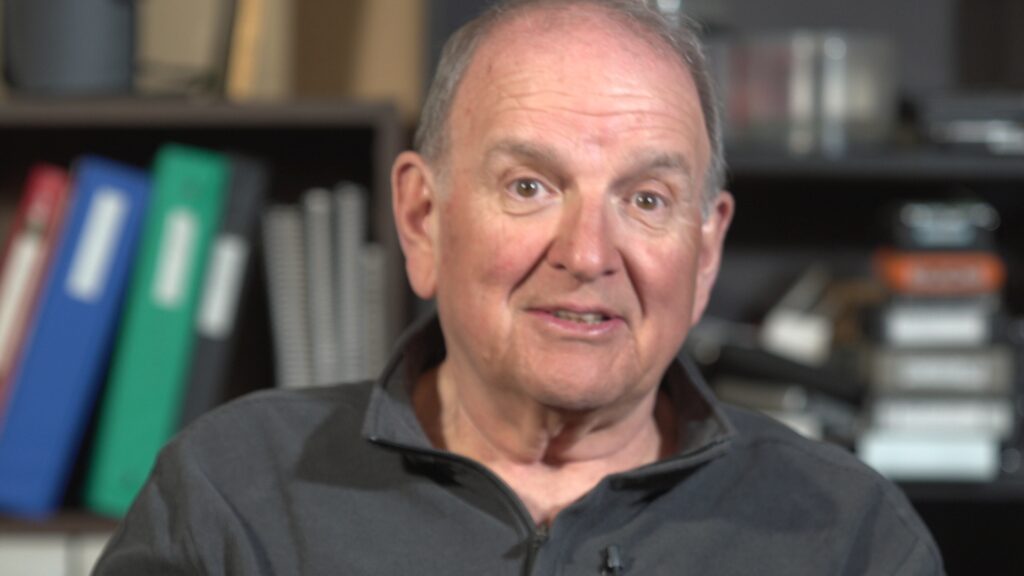
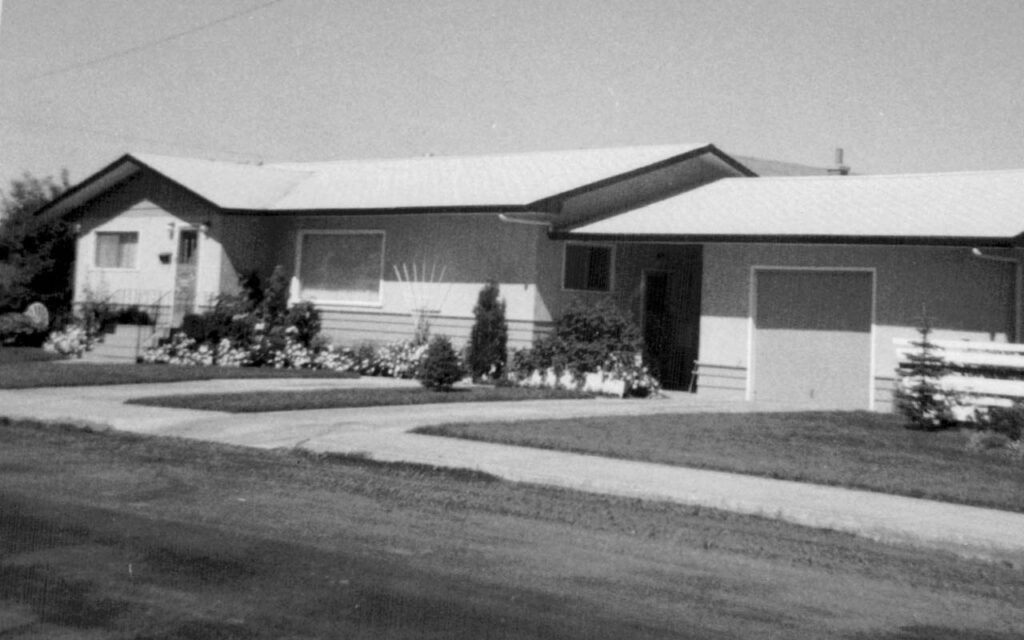
Wayne Krys was born in Jasper Place in the early 1950s where his parents had bought a house in West Jasper Place on the corner of 151 Street and 99 Avenue. He attended Central School, Britannia School, was part of the first graduating class the new Stratford School in 1966; he then went on to Jasper Place Composite High School, graduating in 1970. Krys studied in Education and taught Art in Edmonton Public Schools for 32 years. He still lives in the Jasper Place area.
The Krys and Cuff families were neighbours, and the JPCHP interviewed Wayne Krys side-by-side with George Cuff; Cuff tells stories about Jasper Place in the ‘50s and ‘60s from a different perspective.
In this video clip, Wayne Krys describes their house and yard and tells a story about how he was almost born in the ditch.
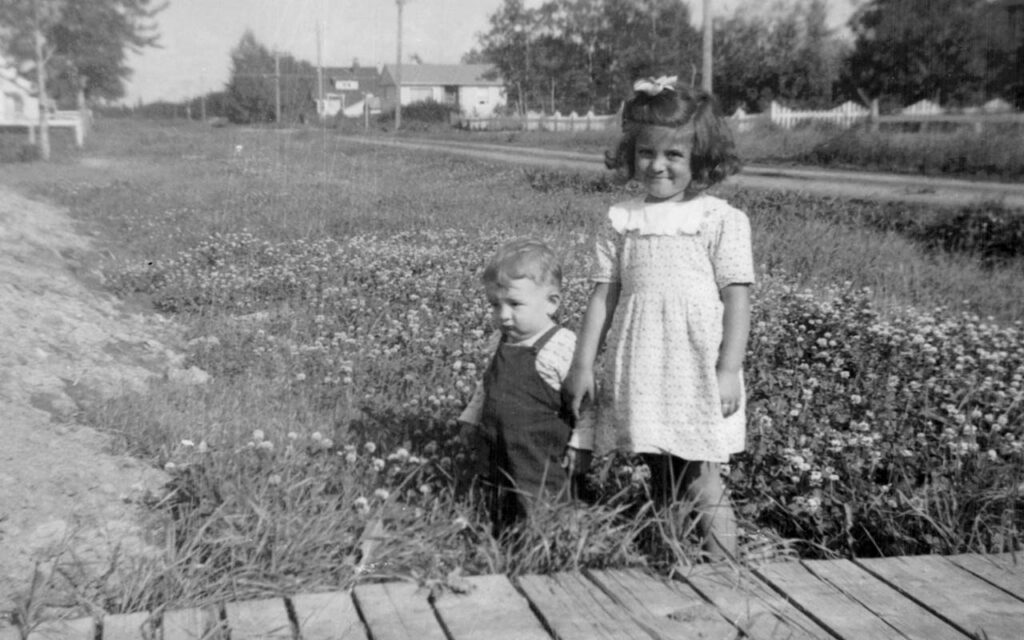
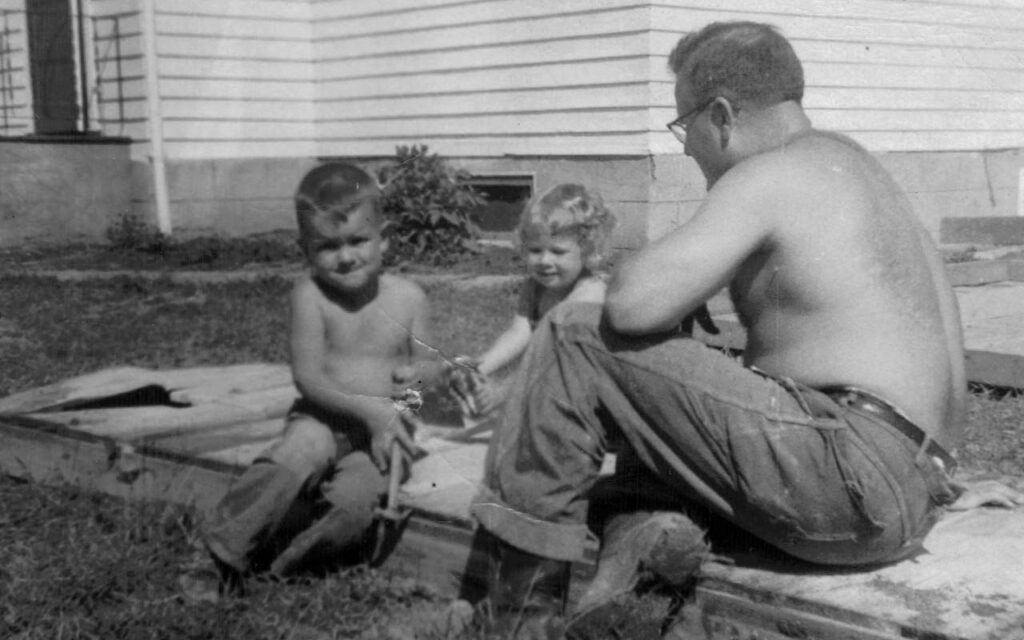
He talks about the huge garden the family had, as did most other families in Jasper Place, about needing to enhance the soil, the wonderful harvest that resulted, and the canning, freezing, and storing that had to be done. As for groceries:
…nobody had a car, so you did a major shop at someplace like Safeway and carried the bags home. But for day-to-day things like milk, there were corner stores; almost every corner, every second block, there were corner stores, and they’d just send the kids down. I remember being sent for […] milk and bread and other things like that. A loaf of bread then was 10 cents; 10 cents would last me a week when I was a kid. There was a Clock Grocery that later became Clock IGA on Stony Plain Road, but they used to be on 149th Street and they were just Clock Grocery because they had a big clock standing out in front of their store on a pole. They had a panel van, and my mom would phone the order in, and they would deliver it. If we weren’t home, they’d just bring it in the house. Nobody locked their doors, so they’d put it in the house so it didn’t freeze. That was [necessary] because [Mom] had two small kids and couldn’t carry groceries and two small kids. That was how we often got our groceries.
His father, Jack Krys, continually improved the house:
About 1960 my father decided that he wanted a brand new three-bedroom bungalow, but instead of starting from scratch he had a new basement dug and poured in adjacent to the old basement. He built onto it and restyled [our house] so it looked like a brand-new home and added a garage onto it, so the house seemed to go from the street to the alley. We were by far the largest spread-out house in the neighbourhood, except for one rich guy who lived across the street – [Mr.] Holloway.
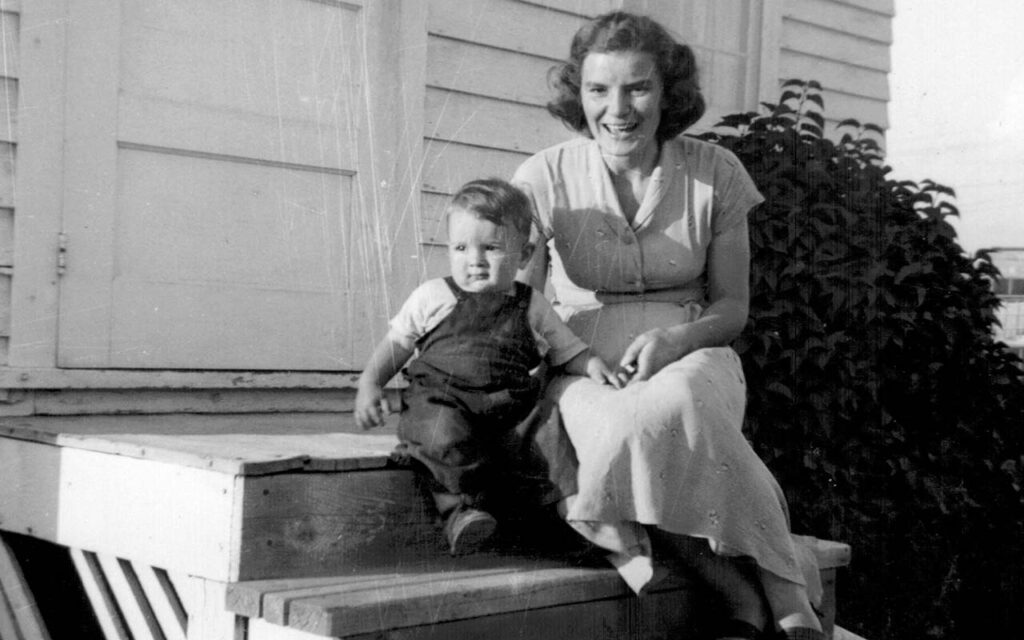
Here, Wayne Krys talks about playing in the streets with other kids, and what happened in the springtime when the streets were muddy and oiled; going to the movies at the school and to the Star-Lite Drive-In.
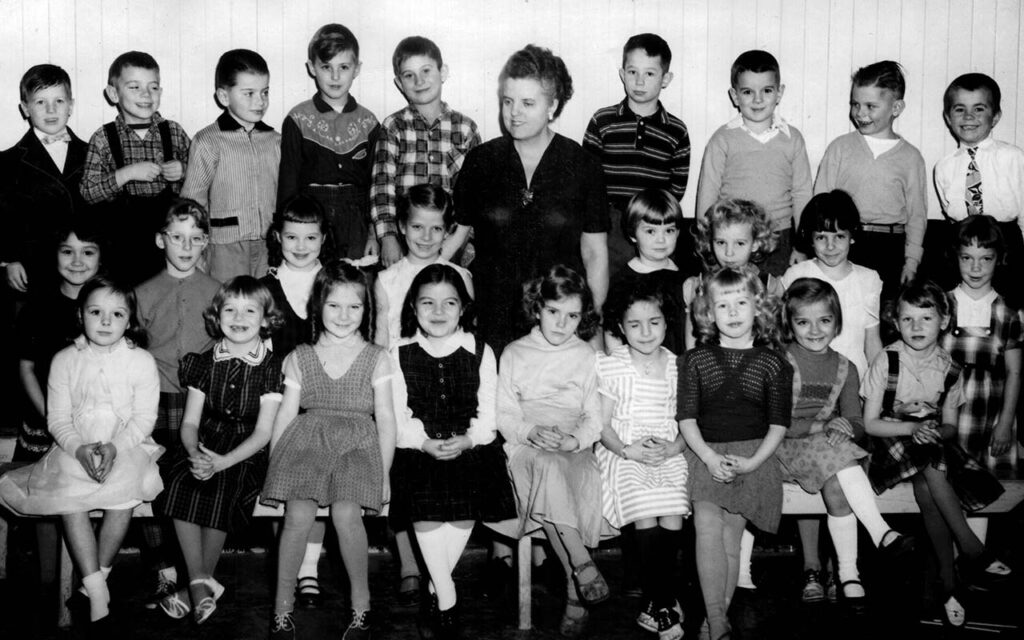
During the interview, Krys reminisces fondly about Mrs. Carlson, a special teacher at Central School:
Mrs. Carlson earlier, she was our Grade 1 teacher. I think she was everyone’s Grade 1 teacher that you’d speak to who grew up in [our part of] Jasper Place. She was later on our paper route and kept in touch with my sister and I until her death in the 1990s. She retired to B.C. and lived out there, and she would send a Christmas card with a letter in it every year – all those kinds of things – and was just interested in what you did with your life 40 years later.
Both Krys and Cuff worked as “paper boys” for the Edmonton Journal out of the Jasper Place “paper shack” on Stony Plain Road a bit west of 148th Street: “There were always kids waiting for a paper route. It was an opportunity to make some money.” They exchange memories about how hard the work was but how it paid well because there were additional jobs that they were able to do. Krys also worked at the West Jasper Place “paper shack” further west on Stony Plain Road and 156th Street.
Krys notes that he “had absolutely different teenage years and formation than George [Cuff],” joining Cubs and Scouts in Crestwood and became friends with many kids there, even though no one on either side of 149th Street went to schools in the other side. He eventually played in a band with people in Crestwood, but doesn’t “remember Crestwood kids coming over and playing in Jasper Place,” mainly because, he says, “Jasper Place had a reputation – lower class, rougher neighbourhood.”
He and Cuff also talk about the MacKinnon Ravine freeway project and how it would have affected Jasper Place, and about Margarette Chappelle, the person who organized people to stop it.
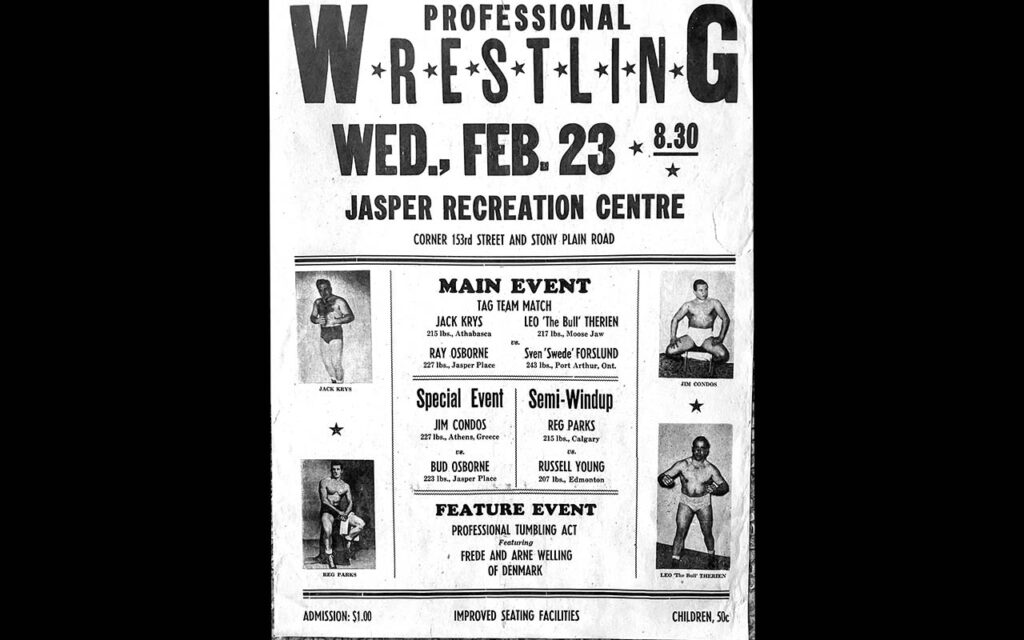
Wayne Krys’s father, Jack, was “a store manager, a merchant who wrestled […] on the side”:
I have a poster, and my dad never mentioned this. [… This] poster [was found among] his belongings after his death. On 153rd Street and Stony Plain Road where there’s now an antique mall, that building was a poolhall when we were kids. But it used to be… they called it Jasper Place Recreation Centre at that time. They had a wrestling promotion there in the early 1950s, again featuring all the local wrestlers. But beyond that, the only time I remember wrestling in Jasper Place was the grand opening of the Jasper Place Recreation Centre [link to https://jasperplacehistory.org/jasper-place-sports-centre/], what’s now Bill Hunter Arena. They had all Jasper Place wrestlers. Arnie Holmes, who was quite athletic and an assistant principal at Jasper Place High School, was one of the wrestlers. Then they had some of the Stampede wrestlers, from Texas actually, who were up here, who were the main event.
Krys and Cuff discuss the presence of Indigenous students who were bussed to schools in Jasper Place from residential schools in the area, and how skilled they were as basketball players. The two friends attended some shows with the musical group, the Chieftones, and comment on how talented the group was. They also mention that they played with the Lipscombe and the Brown children, two Black families who had migrated to Jasper Place from Amber Valley. Krys and Cuff feel that there was there was no discrimination or racism shown towards either the First Nations students or the Black families, mainly because, as George Cuff says, “…we were all poor, and poverty kept us all equal.”
Krys’s step-grandfather was Secretary-Treasurer for the Town of Jasper Place. In this clip, Krys tells a story about how his step-grandfather bought gloves for the police at the Jasper Place Department Store; this morphs into a description about policing and public safety in the Town. He then expands on the Jasper Place Department Store, and how he helped Mrs. Mark, the store’s seamstress, in providing excellent customer service.
When asked about his experiences at the Jasper Place Composite High School between 1966 and 1970, Wayne Krys says:
I remember the vastness of the place. It stretched for blocks. You’d have three minutes to get three or four blocks if you had the misfortune to have classes at opposite ends. There was 2,500 kids there. [….] You had a core group that met at lunchtime and before and after school, but in your classes, there were just so many people. That was something I’d never experienced before. I’d always had the same kids in my classes, day in and day out. It was a real experience. I forget what they called it – open campus I believe, an experiment where they suddenly said, well there’s no rules. You come and go as you please, there’s no attendance anymore. They allowed smoking in the school and a whole bunch of things for one year. I guess it was bad news, because that principal was never heard from again and a new law-and-order principal was put in there. I don’t know what they were thinking when they did this. [….] They had ashtrays in the hallways. They asked us to not smoke in the bathrooms, because it would get so smoky in there that you couldn’t see. Crazy times.